How to Expunge a Class D Felony in Indiana (Eligibility & Waiting Periods Explained)
If you were convicted of a Class D felony in Indiana before July 1, 2014, you may be wondering whether expungement is possible. The good news: many Class D felonies can be expunged under Indiana law, but eligibility depends on the specific offense, how much time has passed, and your criminal history since the conviction.
This guide explains what you need to know about Class D felony expungement in Indiana, including waiting periods, eligibility requirements, and what happens after your record is sealed.
What Is a Class D Felony?
Indiana's Old Felony Classification System
Before July 1, 2014, Indiana categorized felonies from Class A (most serious) to Class D (least serious). Class D felonies carried sentences ranging from six months to three years in prison, with fines up to $10,000.
Common Class D felonies included:
Theft (certain amounts)
Possession of marijuana or controlled substances
Battery resulting in injury
Criminal conversion
Check fraud
The Shift to Level 6 Felonies
On July 1, 2014, Indiana restructured its criminal code. Most Class D felonies became Level 6 felonies under the new system. While the terminology changed, the expungement process for these older convictions follows the same rules outlined in Indiana Code § 35-38-9.
Are Class D Felonies Eligible for Expungement?
General Eligibility Rule
Most Class D felonies qualify for expungement under IC § 35-38-9-3, provided you meet specific requirements:
Eight-Year Waiting Period: You must wait at least eight years from your conviction date before filing a petition. The prosecutor may consent in writing to a shorter period, but this is discretionary.
Clean Record: You cannot have been convicted of any felony or misdemeanor during the eight-year waiting period (or shorter period if the prosecutor consented).
No Pending Charges: You must have no criminal charges pending against you at the time of filing.
Financial Obligations Satisfied: All fines, fees, court costs, and restitution must be paid in full.
Court Discretion
If you meet these requirements, the court shall order your Class D felony records expunged. This is different from more serious felonies where expungement is discretionary.
When a Class D Felony Cannot Be Expunged
Indiana law excludes certain Class D felonies from expungement eligibility under IC § 35-38-9-3(b). You cannot expunge your conviction if:
You were an elected official or judicial officer convicted of an offense while serving or as a candidate
You are a sex or violent offender as defined in IC § 11-8-8-5
Your felony resulted in bodily injury to another person
You were convicted of perjury (IC § 35-44.1-2-1) or official misconduct (IC § 35-44.1-1-1)
You were convicted of an offense under IC § 35-42-1 (homicide), IC § 35-42-3.5 (human trafficking), or IC § 35-42-4 (sex crimes)
You have two or more felony convictions involving the unlawful use of a deadly weapon that were not part of the same episode of criminal conduct
If your Class D felony falls into one of these categories, you may still be eligible for expungement under IC § 35-38-9-4 or § 35-38-9-5, but the waiting periods are longer and the court has more discretion to deny your petition.
Can a Class D Felony Be Reduced to a Misdemeanor?
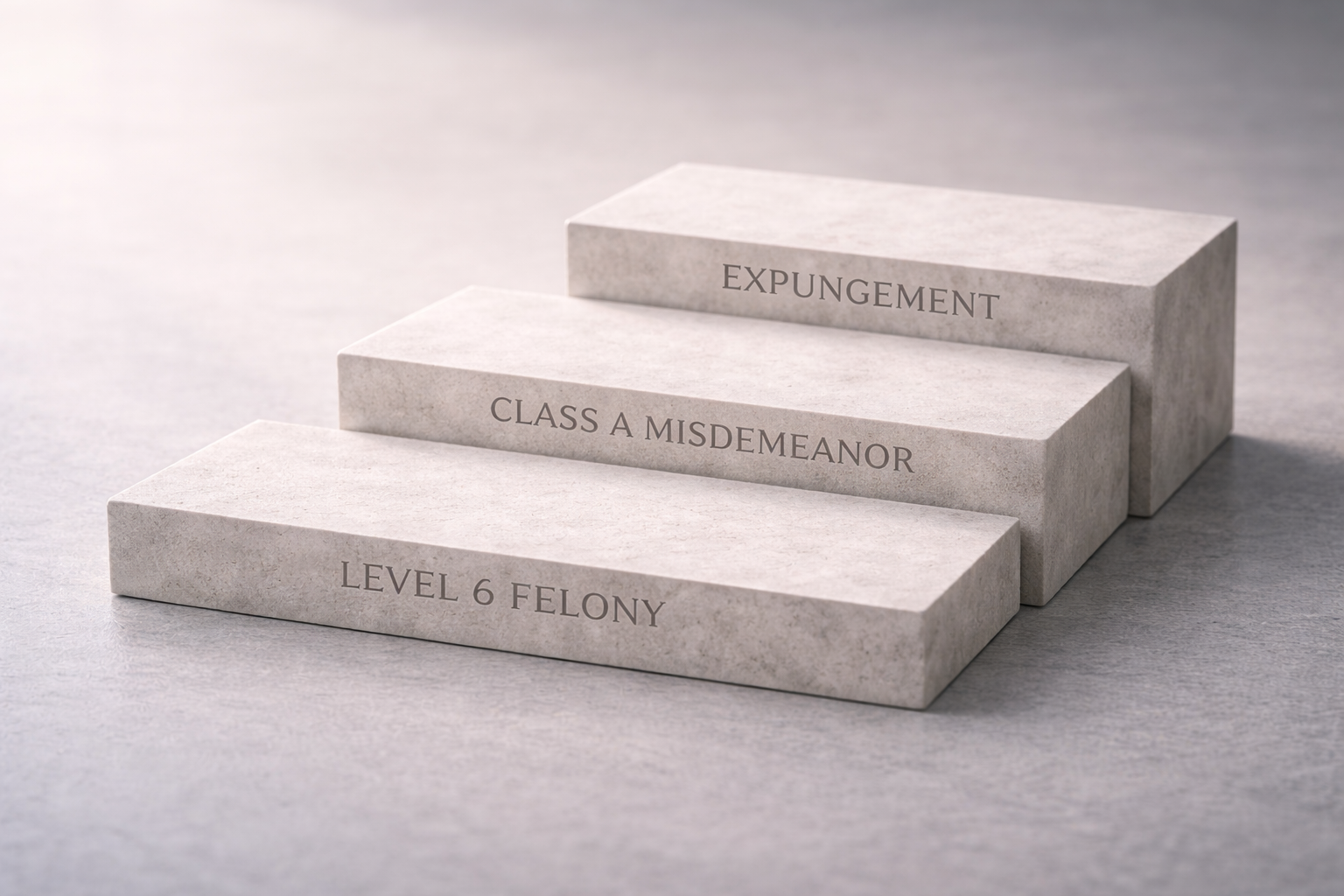
Yes. Under Indiana Code § 35-50-2-7, courts may reduce certain Level 6 felonies (formerly Class D felonies) to Class A misdemeanors under specific circumstances.
Reduction at Sentencing
At the time of sentencing, a court may enter judgment of conviction as a Class A misdemeanor instead of a felony. However, the court must enter a felony conviction if:
You previously had a felony reduced to a misdemeanor less than three years before the current offense
The offense is domestic battery
The offense is possession of child sex abuse material
Post-Conviction Reduction
You may also petition the court to reduce your Class D or Level 6 felony to a misdemeanor after completing your sentence, if:
At least three years have passed since you completed your sentence and satisfied all obligations
You are not a sex or violent offender
Your conviction did not result in bodily injury to another person
You have not been convicted of perjury or official misconduct
You have not been convicted of domestic battery as a felony in the 15 years before the current offense
You have not been convicted of any felony since completing your sentence
No criminal charges are pending against you
Reducing your felony to a misdemeanor first may make expungement faster and more straightforward, as misdemeanor expungement has a shorter five-year waiting period.
What Happens After a Class D Felony Is Expunged?
Records Are Sealed
When the court grants expungement under IC § 35-38-9-3, your conviction records are permanently sealed. This means:
Court files are sealed
The Indiana State Police Department seals records in the central criminal history repository
The Department of Correction, Bureau of Motor Vehicles, and law enforcement agencies are prohibited from releasing your records without a court order (except to law enforcement officers acting in their official capacity)
Limited Access Remains
Sealed records may only be disclosed to:
Prosecuting attorneys (with court order, for official duties)
Defense attorneys (with court order, for professional duties)
Probation departments (with court order, for presentence reports)
FBI and Department of Homeland Security (if required by federal agreement)
Indiana Supreme Court and State Board of Law Examiners (for bar admission character evaluations)
Schools (for employment or access decisions involving student contact)
You Can Deny the Conviction
After expungement, you may legally state that you were never convicted of the offense. Applications for employment, housing, and professional licenses may only ask about criminal records in terms that exclude expunged convictions, such as: "Have you ever been arrested for or convicted of a crime that has not been expunged by a court?"
Firearm Rights
Expungement of a Class D felony does not automatically restore your right to possess a firearm. If your conviction was for domestic battery, Indiana law specifically states that expungement does not restore firearm rights. Restoration of firearm rights requires a separate legal process under IC § 35-47-4-7.
Expunged Convictions Can Still Be Used
While your record is sealed from public view, an expunged conviction may still be:
Considered by a court when sentencing you for a new offense
Used to enhance a new offense or support a habitual offender charge
Admitted as evidence in a new criminal proceeding
Common Questions About Class D Felony Expungement
Do I have to go to court?
If the prosecutor does not object to your petition, the court may grant expungement without a hearing. If the prosecutor files an objection, the court will schedule a hearing where both sides can present arguments.
Will the prosecutor object?
The prosecutor has 30 days to respond to your petition. If they do not respond, they waive any objection. Even if they object, the court must still grant expungement if you meet all statutory requirements under IC § 35-38-9-3.
Can I expunge multiple Class D felonies at once?
Yes. You must consolidate all convictions from the same county into one petition. If you have convictions in multiple counties, you must file a separate petition in each county.
What if I forgot to include a case?
Indiana law generally allows only one expungement petition per lifetime. If you forgot to include a conviction, the court may permit you to file an amended petition only if you can show:
You intended in good faith to comply with the law
Your omission was due to excusable neglect or circumstances beyond your control
Allowing the amendment is in the best interests of justice
Can my petition be denied?
If you meet all requirements under IC § 35-38-9-3, the court shall grant your petition. The court may only deny your petition if:
The required waiting period has not elapsed
You have pending criminal charges
You have not paid all fines, fees, and restitution
You were convicted of a crime during the waiting period
Your offense is excluded under IC § 35-38-9-3(b)
Strategic Considerations Before Filing
Before filing your expungement petition, consider these steps:
Review Your Entire Criminal History: Obtain certified copies of all convictions from every Indiana county where you have been charged. Missing a conviction can complicate your petition or disqualify you entirely.
Confirm Waiting Periods: Calculate the eight-year period from your conviction date (not your arrest or sentencing date). If you are close to the deadline, waiting a few extra months ensures compliance.
Coordinate Multi-County Filings: If you have convictions in multiple counties, file all petitions within the same 365-day period to count as a single lifetime petition.
Anticipate Objections: If your offense involved violence, drugs, or significant harm, the prosecutor may object even if expungement is mandatory. Be prepared to address these concerns at a hearing.
Evaluate Reduction First: If you are eligible to reduce your Class D felony to a misdemeanor under IC § 35-50-2-7, consider filing for reduction before expungement. A misdemeanor has a shorter five-year waiting period and may be less likely to draw objections.
When Should You Speak with an Indiana Expungement Lawyer?
Expungement law is technical, and mistakes can delay or jeopardize your petition. You should consult an experienced Indiana expungement lawyer if:
You have multiple felony convictions across different counties
You are unsure whether your offense qualifies for expungement
A prior expungement petition was denied
Your job, housing, custody rights, or professional license depends on clearing your record
You want to explore felony reduction before expungement
An attorney can review your full criminal history, confirm eligibility, prepare and file your petition, respond to prosecutor objections, and represent you at hearings to maximize your chances of success.
Ready to take the next step? Call or text (317) 759-3225 or schedule an appointment below to discuss your Class D felony expungement and explore your options for a fresh start.



Reading about the problem is one thing. Dealing with it is another.
If this issue is affecting you, your family, your case, or your career, the next step is understanding how the law applies to the facts in front of you. Tell us what is happening and Vining Legal can help you determine what needs attention next.
We personally respond within 2 hours, 8am–8pm, seven days a week.
Vining Legal · Indianapolis, Indiana
Family Law · DCS · Criminal Defense · Appeals
