Can a Level 4 Felony Be Expunged in Indiana? Serious Felony Expungement Rules
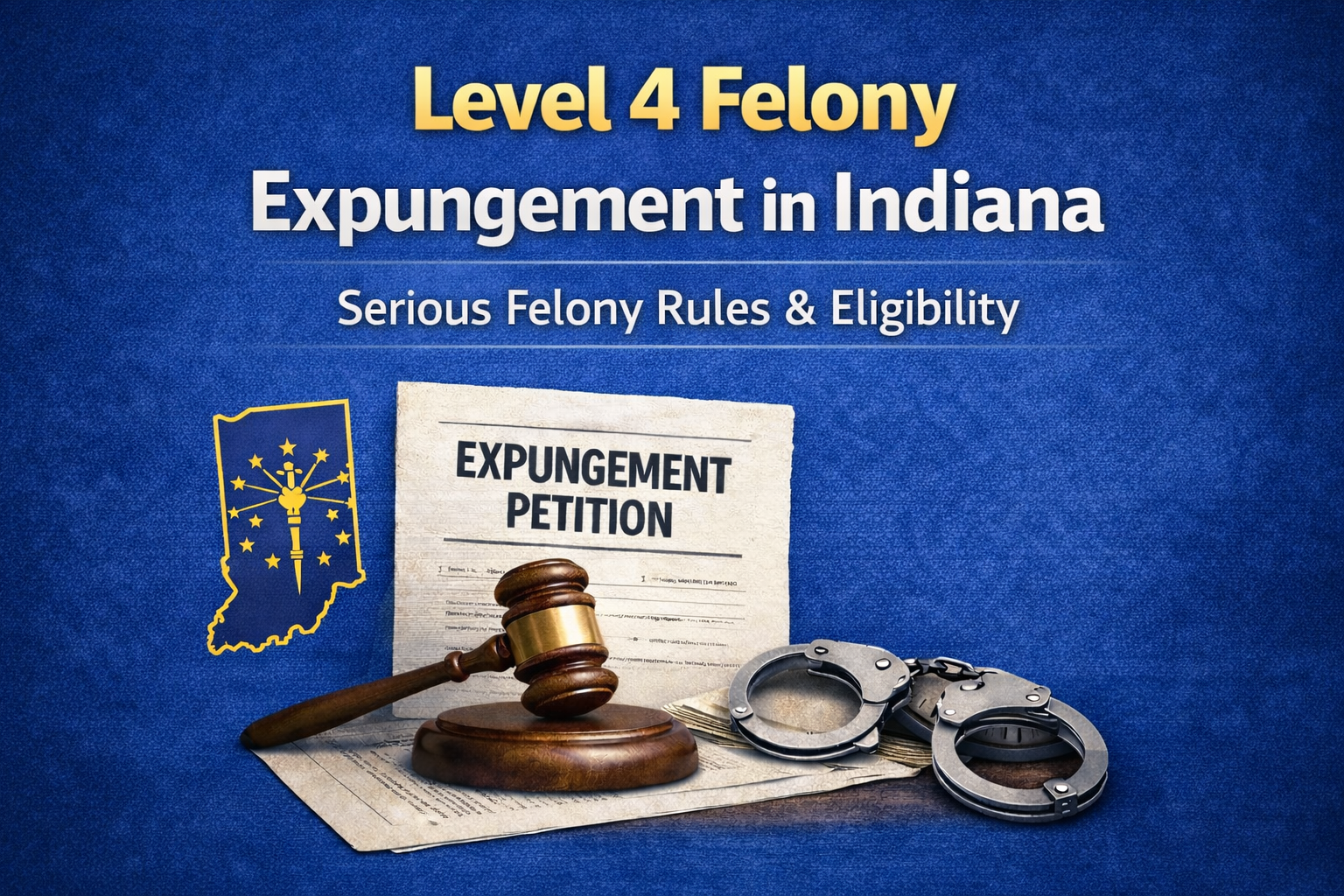
A Level 4 felony conviction can follow you for years—affecting your ability to find work, secure housing, or obtain professional licenses. But Indiana's expungement law, often called the Second Chance Law, may allow you to seal that record and move forward with your life.
If you're wondering whether your Level 4 felony qualifies for expungement, this guide will walk you through the legal requirements, the petition process, and what to expect along the way.
Understanding Indiana's Expungement Framework
Indiana Code § 35-38-9 governs expungement in the state. The law divides expungement into different categories based on the severity of the offense and the type of conviction. Level 4 felonies—which replaced Class D felonies after July 1, 2014—typically fall under IC § 35-38-9-4, which covers "less serious felony convictions."
This section allows individuals convicted of certain felonies to petition the court to have their conviction records marked as expunged. However, unlike misdemeanors or Level 6 felonies, expungement under this section is discretionary—meaning the court has the final say, even if you meet all the requirements.
What Does "Marked as Expunged" Mean?
It's important to understand that a Level 4 felony expungement under IC § 35-38-9-4 does not completely erase your record. Instead, the conviction remains in public records but is clearly labeled as expunged. Law enforcement and certain government agencies can still access the full record, but employers, landlords, and licensing boards will see that the conviction has been expunged.
This is different from expungement of misdemeanors or Level 6 felonies, where records are permanently sealed from public view.
Eligibility Requirements for Level 4 Felony Expungement
Not everyone with a Level 4 felony conviction qualifies for expungement. Indiana law sets strict criteria.
Waiting Period
You must wait the later of:
Eight years from the date of conviction, or
Three years from the completion of your sentence (including probation, parole, and any other post-conviction supervision)
The prosecuting attorney can consent in writing to a shorter waiting period, but this is not guaranteed.
Disqualifying Convictions
Even if you meet the waiting period, certain convictions are permanently ineligible for expungement under IC § 35-38-9-4(b). These include:
Convictions of elected or appointed judicial officials while serving or as candidates
Sex or violent offender designations (as defined in IC § 11-8-8-5)
Felonies that resulted in serious bodily injury or death to another person
Official misconduct (IC § 35-44.1-1-1)
Offenses under IC § 35-42-1 (homicide, including attempted murder), IC § 35-42-3.5 (human and sexual trafficking), or IC § 35-42-4 (sex crimes)
Two or more felony offenses involving unlawful use of a deadly weapon, unless committed as part of the same criminal episode
Unlawful possession of a firearm by a serious violent felon (IC § 35-47-4-5)
Additional Requirements
To qualify, you must also:
Have no pending criminal charges
Have paid all fines, fees, court costs, and restitution related to your conviction
Have not been convicted of any felony or misdemeanor within the previous eight years (or a shorter period if the prosecutor consents)
If you fail to meet even one of these conditions, your petition will be denied.
The Expungement Process: Step-by-Step
Filing for expungement involves multiple steps and strict procedural requirements. Missing a deadline or failing to include required information can result in denial.
Step 1: Prepare Your Petition
Your petition must be filed in the circuit or superior court in the county where you were convicted. Indiana Code § 35-38-9-8 outlines what must be included:
Your full legal name and any aliases
Your date of birth, Social Security number, and driver's license number
Your addresses from the date of the offense to the date of filing
Case numbers, conviction dates, and details of any appeals
A statement that no criminal charges are pending against you
A statement that you have not been convicted of another crime within the required period
A copy of the prosecuting attorney's written consent if seeking a reduced waiting period
Details of any prior expungement petitions you have filed
You must also pay the standard civil filing fee unless you qualify for a fee waiver based on indigency.
Step 2: Serve the Prosecuting Attorney
Once filed, you must serve a copy of the petition on the prosecuting attorney in accordance with the Indiana Rules of Trial Procedure. The prosecutor has 30 days to respond.
If the prosecutor does not object within 30 days, they have waived any objection, and the court may grant your petition without a hearing.
Step 3: Respond to Prosecutor Objections
If the prosecutor objects, they must file their reasons with the court and serve you with a copy. The court will then set a hearing not sooner than 60 days after service of the petition.
At the hearing, you must prove by a preponderance of the evidence that the facts in your petition are true. The victim of the offense may also submit a written or oral statement in support of or in opposition to your petition.
Step 4: Court Decision
The court has full discretion to grant or deny your petition. Even if you meet all statutory requirements, the judge may deny expungement if they believe it is not in the interest of justice.
If granted, the court will issue an order directing the Indiana State Police, Bureau of Motor Vehicles, Department of Correction, and other relevant agencies to mark your records as expunged. The order must include all the identifying information from your petition.
Benefits of Expungement
Expunging a Level 4 felony can open doors that have been closed for years.
Employment Opportunities
Indiana law makes it unlawful discrimination for employers to refuse to hire, suspend, or otherwise discriminate against you because of an expunged conviction (IC § 35-38-9-10). You can legally answer job applications by stating you have not been convicted of a crime that has not been expunged.
Housing and Professional Licensing
Landlords and licensing boards are also prohibited from denying you based on expunged records. This is especially important if you work in healthcare, education, or other licensed professions where background checks are routine.
Restoration of Civil Rights
Expungement restores most civil rights, including the right to vote, hold public office, and serve on a jury. However, if your conviction involved a crime of domestic violence, your right to possess a firearm is not automatically restored and must be addressed separately under IC § 35-47-4-7.
Limitations You Should Know
While expungement offers significant relief, it does not erase your past entirely.
Use in Future Prosecutions
If you are arrested or convicted of a new offense, your expunged Level 4 felony conviction can still be:
Considered by the court in determining your sentence
Used as a prior conviction for habitual offender enhancements
Admitted as evidence in the new proceeding
Law Enforcement Access
Records marked as expunged remain accessible to law enforcement, prosecutors, probation departments (for presentence reports), and certain government agencies. They are not hidden from the criminal justice system.
One-Time Petition Rule
You may file a petition for expungement only once in your lifetime (IC § 35-38-9-9(i)). This applies to all convictions across all counties. If your petition is denied, you may refile only if the denial was based on the court's discretion—and even then, you must wait three years before refiling.
Common Reasons for Denial
Many petitions are denied due to avoidable mistakes:
Incomplete petitions: Missing required information or failing to attach necessary documents
Outstanding fines or fees: Even small amounts of unpaid restitution can disqualify you
Recent convictions: A conviction within the eight-year lookback period will result in denial
Disqualifying offenses: Attempting to expunge an ineligible conviction
Prosecutor objection: The prosecutor may argue that expungement is not in the public interest, and the court has discretion to agree
Working with an attorney who understands Indiana expungement law can help you avoid these pitfalls.
Take the Next Step Toward a Fresh Start
Expunging a Level 4 felony is not automatic, but it is possible—and it can make a real difference in your life. If you meet the eligibility criteria and are ready to move forward, the sooner you act, the better.
At Vining Legal, we've helped clients across Indiana navigate the expungement process and protect their future. We'll review your conviction, determine your eligibility, and prepare a petition designed to give you the best chance of success.
Call or text (317) 759-3225 or schedule a consultation below to discuss your case and explore your options.






Reading about the problem is one thing. Dealing with it is another.
If this issue is affecting you, your family, your case, or your career, the next step is understanding how the law applies to the facts in front of you. Tell us what is happening and Vining Legal can help you determine what needs attention next.
We personally respond within 2 hours, 8am–8pm, seven days a week.
Vining Legal · Indianapolis, Indiana
Family Law · DCS · Criminal Defense · Appeals
